From an air quality initiative to a national mission, the collaboration aims to build a sustainable developer community in Thailand powered by on-device AI technology.
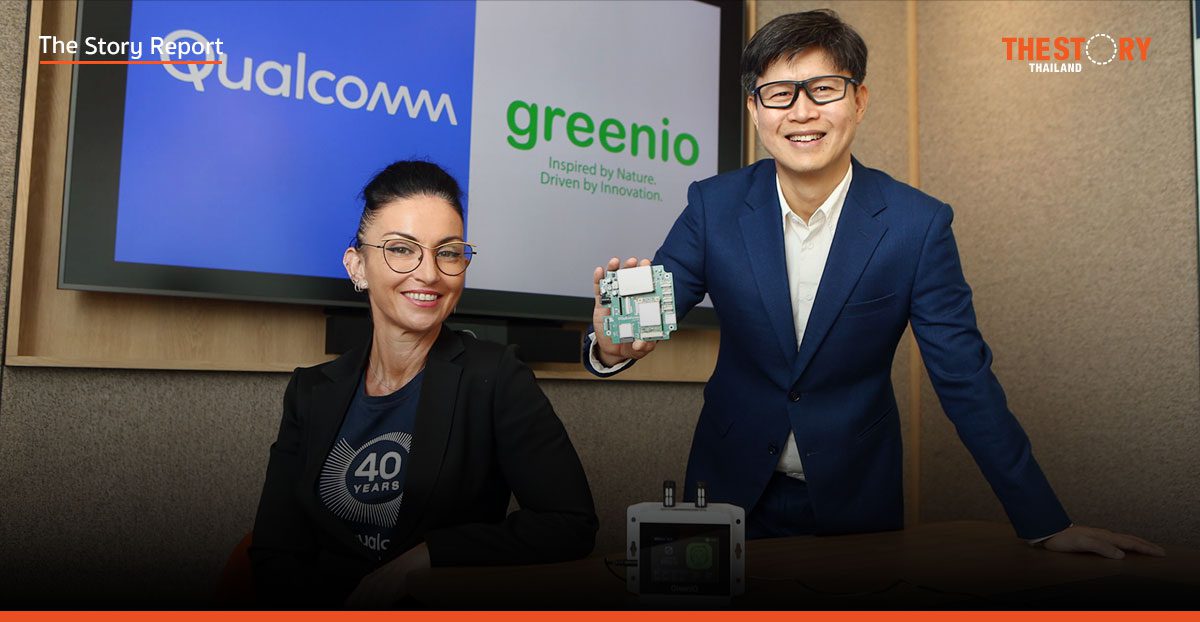
A partnership between global technology giant Qualcomm and Thai-born startup GreenIO, which began as a social impact project to monitor air pollution, is revealing a far more ambitious vision: to lay the groundwork for a self-sustaining, Thai-led AI ecosystem. By leveraging the power of on-device AI (or Edge AI), the collaboration aims to unlock the potential of local developers and fundamentally reshape Thailand’s digital economy.
The project’s origin lies in “Qualcomm® Wireless Reach™,” a long-standing global initiative dedicated to using technology for social good. “We saw a clear alignment between Thailand’s air pollution challenges and the government’s ‘Thailand 4.0’ vision, which champions innovation-driven solutions,” said Sharon Alalouf, Sales Director for Qualcomm CDMA Technologies Asia-Pacific. “We chose to fund GreenIO, a local company with deep expertise and a genuine understanding of the national context.”
This partnership has already yielded tangible results: 200 “Made in Thailand” air quality monitoring devices. These units, designed and manufactured entirely by GreenIO, have been strategically installed in sensitive locations such as schools and hospitals across Bangkok and in Northern Thailand, a region annually affected by severe PM2.5 haze.
The devices go beyond standard metrics, measuring not only PM2.5 and PM10 but also CO2 (to assess population density), temperature, humidity, and Total Volatile Organic Compounds (TVOCs), which can be carcinogenic. Data is transmitted via a 4G network to a cloud-based dashboard for real-time analysis. Critically, to ensure safety in medical environments, GreenIO secured certification from Thailand’s National Broadcasting and Telecommunications Commission (NBTC), confirming the devices do not interfere with sensitive medical equipment—a testament to their professional-grade standard.
At the heart of this initiative is the strategic use of on-device AI. Unlike cloud-based AI, which requires constant data transmission, edge AI processes information directly on the device itself.
Itthichai Phoomsirivilai, Managing Director and Co-Founder of GreenIO, explained the technology’s significance. “It’s like putting a brain inside each small device,” he noted. This approach offers three key advantages:
Efficiency: It dramatically reduces power consumption and data bandwidth, as only essential results (e.g., a vehicle count) are transmitted, not a continuous video stream.
Low Latency: Processing occurs instantly at the source, enabling rapid response times crucial for time-sensitive applications.
Data Privacy: Sensitive information is processed and remains on the device, a critical feature in an era of heightened data security concerns.
“AI has two parts: training, which is like teaching a child and requires immense cloud computing power, and inference, which is applying that knowledge in the real world,” Itthichai analogized.
“Qualcomm’s on-device AI technology perfectly addresses the inference part.”
However, the vision extends far beyond clean air. The project is positioned as a launchpad for a larger developer community. The next step is to create an “Education Board”—a toolkit powered by Qualcomm chipsets—that will empower Thai students and developers to build their own on-device AI applications.
“We don’t want to rely on funding forever; we want to build a sustainable system,” said Itthichai. “By creating a community of Thai developers who understand this technology, we can foster new business domains and build a new economy for Thailand, reducing our reliance on expensive imported technology.”
The business model prioritizes community growth over licensing fees, with the belief that a strong user base will naturally generate revenue through hardware sales and supplementary services like training.
From Qualcomm’s perspective, this is a model of synergistic partnership. “This wasn’t a top-down idea from headquarters; it was a dream we built together with our local partner,” said Alalouf. He emphasized that solutions born in Thailand have the potential for global application, citing Latin America as another region where such innovations could be adapted.
“Thailand has enormous potential to drive digital transformation,” Alalouf concluded. “Qualcomm is committed to supporting Thai companies and developers in creating new solutions that could scale across the region and beyond.”
This investment is part of Qualcomm’s broader strategy in the country, with the company actively exploring opportunities in Thailand’s agriculture and renewable energy sectors. The collaboration is therefore more than just an environmental project; it is a strategic investment in human capital and technological infrastructure, designed to empower Thailand to compete on the global stage with the strength of its own innovators.
Beam unveils ‘Bolt+,’ A revolutionary One-Tap payment device
Gartner forecasts worldwide AI spending will total $1.5 trillion in 2025