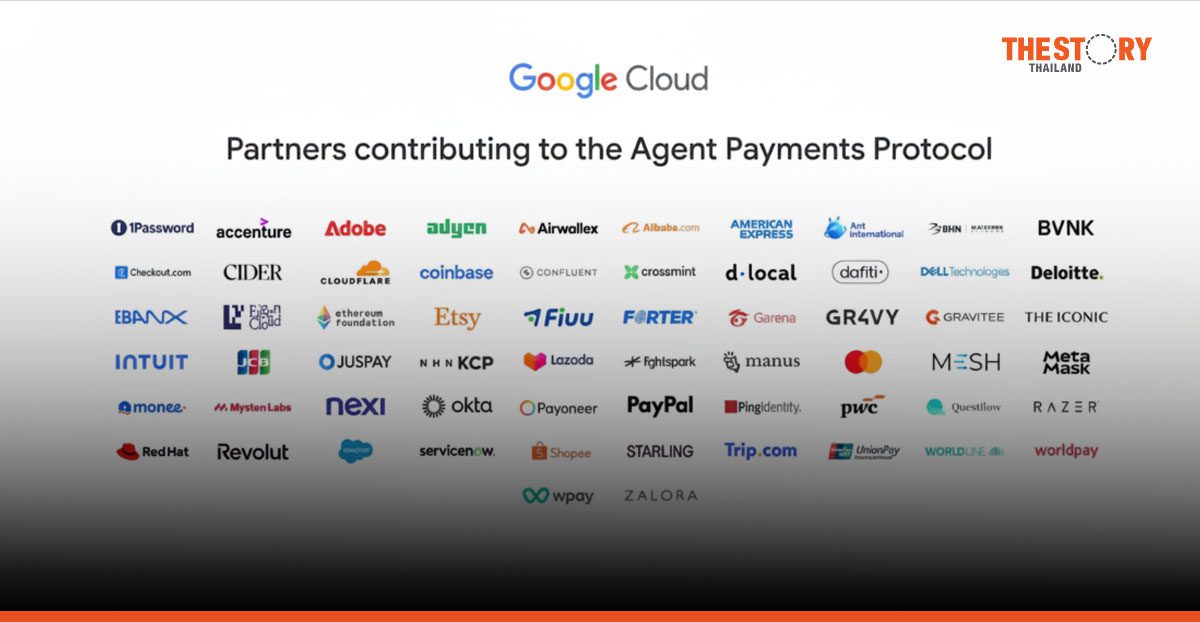
Google Cloud, in collaboration with over 60 global payment and technology leaders, today announced the Agent Payments Protocol (AP2), a new open standard designed to create a secure and universal framework for AI agents to conduct transactions on behalf of users.
The initiative brings together key Southeast Asian players like Shopee, Lazada, Garena, and Airwallex, alongside international giants such as Mastercard, PayPal, American Express, and Coinbase, to build a common foundation for the burgeoning agent economy.
The rise of autonomous AI agents capable of executing tasks breaks a fundamental assumption of modern e-commerce: that a human is always the one directly clicking the “buy” button.
This shift introduces critical challenges regarding authorization, authenticity, and accountability in digital payments. AP2 is designed to address these gaps by providing a common language for agents, merchants, and payment providers to transact with confidence across all payment methods.
“AP2 is an open, shared protocol that provides a common language for secure, compliant transactions between agents and merchants, helping to prevent a fragmented ecosystem,” said Rao Surapaneni, Vice President and General Manager, Business Applications Platform at Google Cloud.
“This helps ensure a consistent, secure, and scalable experience for users and merchants, while also providing financial institutions with the clarity they need to effectively manage risk.”
The collaboration underscores a broad industry consensus on the need for a standardized approach.
“Mastercard is committed to ongoing, responsible innovation, and we’re excited to be collaborating with Google, leading banks, merchants, AI platforms, and other industry leaders to help shape the future of agentic commerce,” said Pablo Fourez, Chief Digital Officer at Mastercard.
David Chen, Chief Product Officer at Shopee, added, “At Shopee, we see immense potential for agents to transform e-commerce, and believe that industry protocols such as Google’s AP2 will be critical to enabling this future.”
How It Works: Establishing Trust Through Digital ‘Mandates’
At the core of AP2 is a system of “Mandates”—tamper-proof, cryptographically-signed digital contracts that serve as verifiable proof of a user’s instructions. These mandates create a secure, unchangeable audit trail for every transaction.
The protocol addresses two primary scenarios included:
Real-time Purchases: When a user asks an agent to find a product, their request is captured in an “Intent Mandate.” Once the user approves the final cart, a “Cart Mandate” is signed, creating a secure record of the exact items and price.
Delegated Tasks: For automated tasks, such as buying concert tickets the moment they are released, a user signs a detailed “Intent Mandate” upfront, specifying rules like price limits and timing. This pre-authorization allows the agent to automatically generate a Cart Mandate when the precise conditions are met.
This chain of evidence securely links a user’s payment method to a verified cart, establishing a clear foundation for authorization, authenticity, and accountability.
Unlocking New Commerce Experiences
The protocol’s flexible design paves the way for new and sophisticated commercial models. Examples include an agent automatically purchasing a desired item once it becomes available at a specific price, or merchants’ agents creating personalized, time-sensitive bundle offers in response to a customer’s query. The system can also handle complex, coordinated tasks, such as an agent booking a flight and hotel simultaneously while adhering to a total budget.
AP2 is also designed to be a universal protocol, supporting emerging payment systems like stablecoins and cryptocurrencies. In collaboration with Coinbase and MetaMask, Google has already launched an extension, A2A x402, to accelerate support for the Web3 ecosystem.
“Blockchains are the natural payment layer for agents, and Ethereum will be the backbone of this,” said Marco De Rossi, AI Lead at MetaMask. “With AP2 and x402, MetaMask will deliver maximum interoperability for developers.”
A Call for Collaboration in a Booming Digital Economy
The initiative is particularly significant for Southeast Asia, a region where the gross merchandise value of the digital economy exceeded $263 billion in 2024 and digital payments are on track to surpass $2.1 trillion by 2030.
“AP2 provides a trusted foundation to fuel a new era of AI-driven commerce,” said Mark Micallef, Managing Director, Southeast Asia, Google Cloud. “We’re committed to evolving this protocol in an open, collaborative process and invite the entire payments and technology community to build this future with us.”
Google has made the protocol’s technical specifications and documentation available on a public GitHub repository to encourage further innovation and community involvement.
MAKE by KBank data reveals major shift to spending control in Thailand
depa reports Thai Digital Industry Grew 23.35% in 2024