
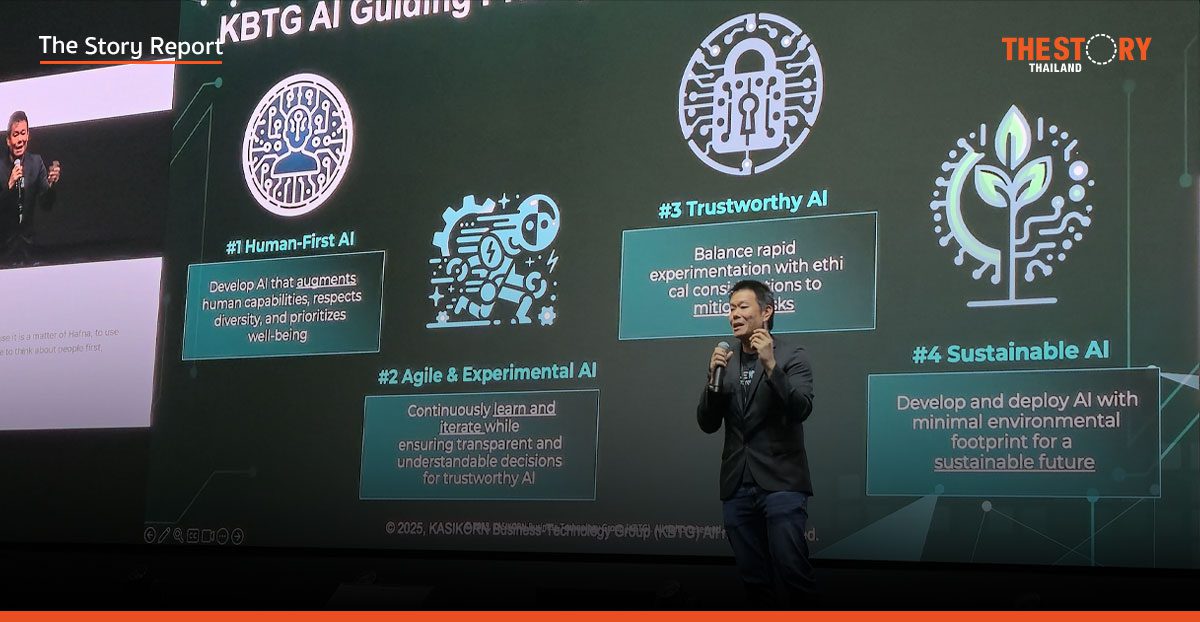
Amidst a decade-long corporate push toward digitalization, Thadpong Pongthawornkamol, Managing Director of Kasikorn Business Technology Group (KBTG), suggests that the era of “Digital Transformation”—which focused primarily on using technology to increase speed—is reaching saturation. He argues that speed alone is no longer sufficient to create a competitive advantage.
According to Thadpong, the new wave replacing this is “Intelligence,” which will be the decisive factor for organizational survival in the next phase. He proposes a model for adapting to “Intelligent Business,” driven by systems that can think and interact, alongside a strategic roadmap for the future.
Redefining Positioning: From IT Arm to “Business Technology”
Thadpong emphasized KBTG’s strategic positioning, clarifying that KBTG is not merely a general Tech Company or an “IT Arm” waiting to code upon request. Instead, it operates as a “Business Technology Group,” reflecting a direction where technology and business are seamlessly integrated.
The mission is divided into two key areas:
- Enablement: Supporting banking businesses within the group to operate smoothly.
- Innovation: Researching new answers to ensure the business remains relevant to society in the future.
This structure is built on a foundation of digital strength, flowing into Data analysis, and culminating in “Intelligence”—the peak of the pyramid that transforms an organization into a fully Intelligent Business.
The 4 Stages of Evolution: Signals of Transition
To analyze the technological context, Thadpong categorized the evolution into four key stages, serving as a gauge for where businesses currently stand:
- The Era of Speed: The genesis of digital, focused on reducing transaction times from hours to seconds—now a basic survival standard for all operators.
- Data Intelligence: Analyzing massive datasets to understand customer context and offer precise products.
- Perception AI: Technology that possesses “eyes and ears,” such as e-KYC via facial scanning, eliminating location constraints.
- Intelligent Automation (The Current Era): The most significant leap, where AI advances from merely receiving information to being able to “Execute” independently. This gives rise to “AI Agents” capable of working on behalf of humans, signaling that businesses must urgently adjust their strategies.
Proven Impact: Tangible Business Results
Moving beyond a modern image, the application of AI must deliver tangible business figures. KBTG provided empirical data reflecting efficiency improvements in three dimensions:
- Revenue Dimension: AI personalization has increased loan conversion rates by 4 times and doubled the efficiency of credit card promotions compared to traditional methods.
- Operational Efficiency: Generative AI has transformed the management of Non-Performing Assets (NPA) by creating simulated room decor images for advertising. This reduced work time from half a day to under one minute per image, accelerating asset liquidation.
- New Business Opportunities (New S-Curve): Technologies like AINU (identity verification via facial scan) have been developed to international standards and spun off to service external companies. This transforms internal support tools into new revenue streams beyond traditional interest income.
Workforce Challenge: From Coder to Foreman
A critical impact on the labor market involves the “Human First, AI First” concept. Thadpong pointed out that current roles are being significantly disrupted. For example, AI Agents can now assist in writing basic code, reducing a task that took half a day to just 10 minutes.
This pressures software developers to evolve from “Coders” (writing commands) to “Foremen” (supervising and verifying accuracy). Furthermore, a new role titled “Business Technology Engineer” is expected to emerge—professionals who deeply understand business context while commanding armies of AI to execute technical tasks effectively.
5 Principles for Leadership in the Intelligent Era
For executives navigating this transition, Dr. Thadpong distilled five key principles:
- Set Clear Goal: Establish clear objectives, such as adhering to “Human First” principles when making decisions about technological changes.
- Concrete Strategy: Allocate resources appropriately by distinguishing which tasks require AI and which still necessitate human skills.
- Platform & Process: Create environments for experimentation, such as a Sandbox or AI Playground, with processes ready to “Scale up” immediately upon success.
- Leader Alignment: Executives must share a unified vision to reduce internal friction. KBTG, for instance, established an “AI Council” that meets every three weeks.
- Measurement: Define KPIs from day one to accurately assess the return on investment.
Thadpong concluded that “Intelligence” is not a passing trend but a business strategy requiring planning, restructuring, and clear measurement. Organizations clinging to old definitions of “digital” risk losing their competitive edge to those who have already advanced into the realm of Intelligent Business.
AIS and Singtel launch ‘Innov8Sparks 2025’ to bridge Thai SMEs to regional markets
Microsoft unveils plan to boost Thailand’s AI growth