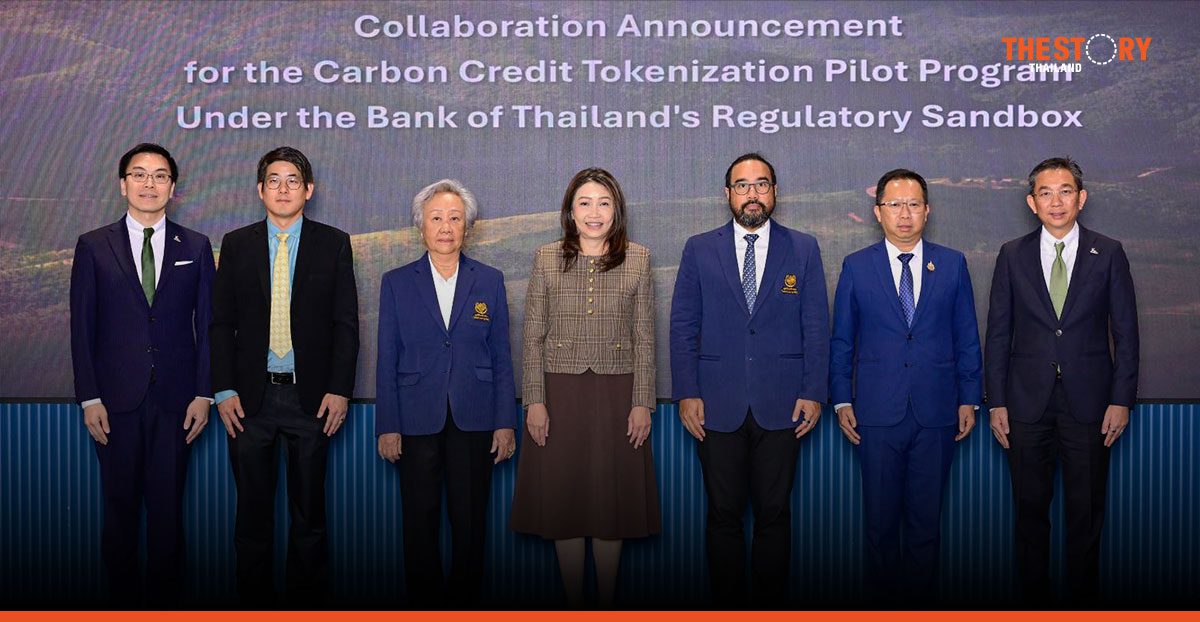
KASIKORNBANK (KBank) is spearheading a major move in Thailand’s green economy by launching the nation’s first Carbon Credit Tokenization Pilot Program. This groundbreaking initiative is a collaboration between KBank, the Mae Fah Luang Foundation under Royal Patronage, the Thailand Greenhouse Gas Management Organization (TGO), Kubix Digital Asset Co., Ltd., and Orbix Technology and Innovation Co., Ltd.
Operating under the Bank of Thailand’s Regulatory Sandbox, the pilot aims to leverage blockchain technology to significantly enhance the transparency, credibility, and operational efficiency of carbon credit trading and offsetting, laying essential groundwork for Thailand’s eventual transition to a mandatory carbon credit market and supporting the national Net Zero goal.
Driving Efficiency and Transparency via Blockchain
Kattiya Indaravijaya, Chief Executive Officer of KASIKORNBANK, stated that the bank is committed to supporting the climate transition toward a low-carbon economy through a comprehensive suite of tools.
“We believe in establishing a robust foundation to support the future mandatory carbon credit market,” Ms. Kattiya said. “This pilot program uses blockchain technology to enhance transparency and efficiency in carbon credit trading and offsetting, serving as foundational infrastructure for future transactions, and aligning with Thailand’s long-term policy direction toward carbon neutrality and Net Zero emissions.”
Under the pilot, KBank will promote the efficient utilization of carbon credits generated from the Doi Tung Development Project.
- Tokenization Process: Kubix serves as the system and technology provider, converting the carbon credits into digital tokens divisible into units of kilograms of carbon dioxide equivalent.
- Blockchain Platform: All processes—including offering, holding, reconverting into carbon credits, and offsetting—are conducted on the Quarix blockchain, developed by Orbix Technology, ensuring traceability and security.
Forest Conservation Credits for Sustainable Development
Dispanadda Diskul, Secretary General and CEO of the Mae Fah Luang Foundation, explained that the carbon credits utilized in this pilot originate from forest conservation and restoration efforts integrated with community development within the Doi Tung Development Project in Chiang Rai.
These credits are registered with TGO under the T-VER standard and are generated by over 11,000 community members actively protecting more than 90,000 rai (approx. 14,400 hectares) of watershed forests. This effort provides effective carbon capture while also ensuring sustainable income for local communities.
TGO’s Role in Regulation and Registry
Nakorn Tangavirapat, Executive Director of TGO, highlighted that TGO will serve as the Registrar, managing the carbon credit registry system. This includes recording certifications, holdings, transfers, cancellations, and issuing cancellation certificates upon completion of offsetting processes.
“This initiative aligns with TGO’s strategic direction to promote the domestic voluntary carbon market, encouraging greenhouse gas reduction and trading by enhancing the utility of carbon credits in various formats,” Mr. Nakorn noted.
Ms. Kattiya concluded by emphasizing that this project is a strategic milestone in developing a transparent and credible voluntary carbon market in Thailand. It actively prepares the country for the transition to a mandatory carbon market and supports Thailand’s ambition to become a regional hub for carbon credit trading, reaffirming KBank’s commitment to developing sustainable green finance solutions.
KBTG ranks among World’s Top 3 for Data & AI impact, recognized by Forrester
Thailand’s PTT taps AI and CCUS in Net Zero push